In the intensely competitive world of today's pro-level oversteer competition, success is far more than solely a product of sheer torque or pilot aggression. Conversely, it is now a intricate science that requires a painstaking fusion of selecting a proven chassis, equipping it with the correct competition components, and, most essentially, grasping its dynamic behavior on the track through sophisticated drift telemetry software. This definitive guide will serve as your master plan starting from the very first concept of a competition vehicle through to the last telemetry-optimized tweaks that elevate a powerful vehicle into a repeatable podium finisher. We will thoroughly explore the precise engineering of vehicle alignment optimization, demonstrating how a modern drift tuning app like GripDial removes approximation and provides unparalleled insight into your chassis's true behavior.
The bedrock of any exceptional competitive sliding vehicle is, undoubtedly, the platform itself. Several platforms have achieved legendary status within the global sliding scene due to their inherent handling characteristics, robust design, and the vast availability of specialist support available. Picking the correct starting point is the primary and most important selection a enthusiast will make. To illustrate, the BMW's E36 3 Series is widely regarded as among the finest all-around drift cars of all time. Its excellent balanced front-to-rear weight, alongside a RWD configuration and extremely reliable inline-six motors, forms a car that is simultaneously accessible for novices and incredibly capable in the control of a expert driver. The successor of this philosophy, the BMW E46, refines these qualities with a increasingly refined frame, increased stance for greater high-speed stability, and yet a greater degree of steering angle as standard from the manufacturer. A distinct formidable option in the professional scene is the C6 generation Corvette.
This American sports car introduces a unique combination of strengths to the sliding sport, featuring a light aluminum structure, a backwards-positioned drivetrain component that helps create an perfect front-to-rear mass ratio, and the colossal low-end power of a big LS-series V8 engine. This blend transforms it into an utter force on track, able of starting and sustaining extended slides with seemingly minimal deployment of acceleration. For builders seeking remarkable value, the Nissan 350Z excels as a top-tier example. It arrives from the factory with a stiff platform, a competent original locking differential, and the responsive V6 powerplant that provides ample horsepower and torque for learning and moving up in the activity. Its successor, the 370Z model, brings further improvements in structural rigidity, steering geometry, and outright motor performance, cementing its place as a common choice among competitive competitors. Other iconic vehicles that merit consideration encompass the lightweight rotary-powered FC generation RX-7, the ever-present S13 Silvia/240SX, the torque-rich Ford Mustang SN95, the electronic-equipped E90 3 Series, and the compact yet incredibly engaging and teachable Mazda MX-5. Each of these cars provides a different palette of traits, challenges, and potentials, but they all possess the core ingredients necessary to become a competitive sliding vehicle.
However, picking the right chassis is merely the first step. To unlock the complete capability of any of these vehicles, major changes to the steering system and damping and springing systems are completely non-negotiable. This is where the world of performance drift-spec hardware becomes sharp focus. The most most game-changing improvement for a purpose-built drift machine is the integration of a drift-spec angle modification kit. These sophisticated systems, such as those engineered by specialist companies like SLR, are designed to radically expand the car's possible lock-to-lock rotation. A factory street car is highly limited in how far its steering tires can pivot, a engineering compromise for public road operation. In drifting, but, aggressive opposite lock is frequently required to control and sustain a slide. An steering kit exchanges the factory steering knuckles, rod ends, and potentially control arms with parts that permit the steered wheels to achieve degrees of turn over 70 or even 80 degrees, compared to a average OEM angle of around 40 to 50 degrees.
This immensely expanded capability provides the driver with dramatically greater authority during a drift, making it much more straightforward to begin a slide, hold it through a long corner, and transition seamlessly from one side to the opposite. The difference in drivability is nothing short of transformative. Combined with a appropriately selected angle kit is the equally essential modification to the chassis's spring and damper setup. Off-the-shelf or even high-end road adjustable suspension are generally not intended for the specific and harsh needs of drifting. A dedicated pair of adjustable dampers is crucial. These engineered coilovers feature unique piston tuning and spring rates that are optimized for the violent weight transfer that is characteristic of sliding. When a pilot starts a slide, the chassis's inertia is transferred rapidly to the outer of the turn. Correct performance suspension handle this shift in a controllable way, enabling the chassis to settle quickly and giving the operator accurate feel through the wheel and seat. They also allow for precise adjustment of ride height, shock absorber rate, and cross-weight, which are all key aspects of fine-tuning the vehicle's dynamics to a particular circuit or driving style. Together, a top-tier angle modification system and a properly chosen pair of drift-spec adjustable dampers form the undeniable mechanical base upon which all subsequent optimization is built.
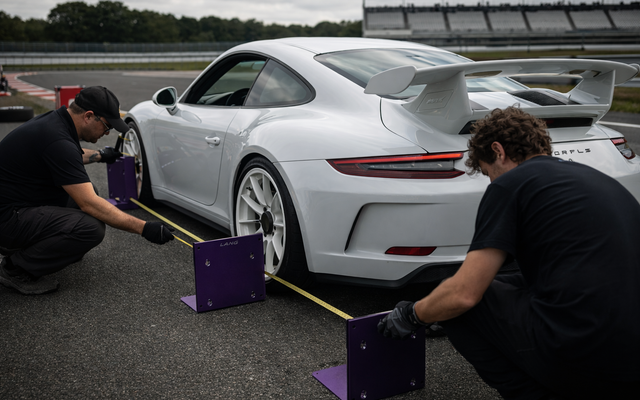
Once the essential hardware is in place, the next essential phase in the project is the detailed adjustment of the vehicle's wheel angles. This is the realm of vehicle alignment optimization, a process that can seem intimidating to the beginner but is, in fact, the defining factor to transforming a assembly of fast components into a harmonious and predictable vehicle. The most discussed aspect of suspension geometry for sliding is certainly negative camber. Camber is the tilt of the rim relative to the upright line when looked at from the front of the chassis. When the upper part of the tire is angled towards the chassis, this is referred to as inward tilt. In oversteer driving, inward-leaning wheels on the front tires is universally used and is regarded as critical. The purpose is intrinsically tied to tire contact.
When a vehicle is turning at extreme slip angles, the chassis rolls toward the outside of the turn. This body roll causes the outside front tire to diminish its best grip area with the track surface. By introducing negative camber, the wheel is pre-angled to compensate for this roll. As the chassis rolls into the turn, the tire flattens out on the road surface, increasing its traction at the precise point when it is most required for steering authority. Usually, front axle angles for a serious sliding vehicle fall between approximately -3 degrees to as high as -5 degrees or even more, contingent on the parameters of the car configuration, rubber choice, and operator preference. The rear wheels also employ inward tilt, but the settings are usually more conservative and subtler than the front axle. Overly aggressive camber at the rear can cause the vehicle to overly loose and hard to manage on power input, as it diminishes drift angle kits the effective tire footprint of the driving tires during forward acceleration. Thus, rear axle camber settings are commonly in the range of -1 degree to -3 degrees, finding a precise equilibrium between giving enough side grip to assist in entering and sustaining the drift while still maintaining usable traction for exiting the bend. camber angle is just one element of the more complex suspension geometry equation, which furthermore encompasses toe setting, caster angle, and steer correction modification.
Toe setting refers to the direction of the wheels as seen from the top. Toe-in means the leading edges of the wheels are closer together than the rear edges, while outward toe means the converse. For drifting, a small amount of front negative toe is commonly used to quicken the initial steering response, making the chassis feel more car suspension tuning responsive and eager to initiate a oversteer moment. Rear axle toe angle is typically set to neutral or a extremely minute amount of positive toe to foster stability under throttle. self-centering is the forward or aft angle of the suspension pivot when observed from the side of the car. Increased positive caster improves self-centering and high-speed confidence, and it additionally increases inward lean gain during steering, which is very advantageous. Tuning these values is a detailed dance where a modification to one setting can and often will affect the others. The old-school process for dialing in a car's suspension geometry for sliding has historically been a tedious endeavor of trial and error. A driver or crew would introduce a adjustment based on a hunch, test the car on track, depend on the driver's individual sensation and feedback, and then make another change. This loop would continue over and over until the car felt "acceptable" or the scheduled testing time ended. This approach is not just extremely wasteful in terms of man-hours and costs, but it is furthermore fundamentally imprecise.
Pilot sensation is a famously subjective data source, affected by many factors such as exhaustion, evolving track grip levels, ambient heat, and merely the mood of the operator on that given day. What feels "oversteery" on one run might feel "tight" on the following pass, resulting in contradictory feedback and frustrating adjustments. This traditional challenge in vehicle dynamics optimization is exactly where state-of-the-art engineering tools has made its mark to revolutionize the process.
The development and adoption of specialized drift telemetry software has brought about a new paradigm for engineering and refining professional drift cars. This new generation of systems, represented by groundbreaking solutions like data acquisition tools, function by physically measuring the live mechanical movement of the chassis as it is piloted on the circuit. As opposed to relying on personal feel, these tools collect measurable information on key factors such as suspension travel, individual tire rotation, lateral and longitudinal g-forces, lock position, and driver input position. This acquired telemetry is then processed by advanced software that can plot and decode the information in a clear way. For the first time, drivers and teams can visualize exactly what the chassis is performing at every point of a drift. This capability revolutionizes the entire suspension tuning workflow. Imagine the specific task of setting the front negative camber for a given vehicle. Instead of applying a change from -3 degrees to -3.5 degrees and then testing several laps to try and "feel" a change, a vehicle dynamics tool can deliver immediate and irrefutable feedback. The application can indicate graphically how the suspension's contact patch is behaving during the most important stages of a drift: the initial flick, sustain, and switch. It can show if the existing value is enabling the loaded tire to maintain optimal loading or if the rubber is overloaded on its outer shoulder.
The software can after analysis suggest empirical suggestions for adjustment. Perhaps the data reveals that the tire is still stressing its outer shoulder at -3.5 degrees of negative camber, implying that an increase to negative camber, say -4 degrees, might be warranted. On the other hand, the data might reveal that the tread is failing to reaching optimal operating temp or that the inner edge is degrading unevenly, which could suggest that there is overly aggressive inward lean and a small reduction back to -3.2 degrees would be more efficient. This level of accuracy and useful insight was literally impossible in the time of exclusively manual setup.
The impact of using a advanced vehicle dynamics tool extends well beyond just dialing in alignment. It becomes an priceless coilover setup tips that is specific to your specific vehicle. When setting the rebound and compression clickers on your adjustable dampers, instead of relying on vague advice or copying another driver's settings, you can use the software to see how the chassis is behaving in response to your changes. The software can show the wheel movement path over a run, highlighting if the shocks are controlling the weight transfer optimally or if they are allowing the vehicle to oscillate uncontrollably after a transition. It can assist in diagnosing problems like excessive compression or excessive extension, permitting you to introduce informed choices to spring preload, rebound/compression rates, or ground clearance. This methodology applies just as well to the detailed process of suspension geometry optimization. Beyond camber angle, the system can give analysis into how adjustments to toe and caster angle are impacting the chassis's stability during various parts of a lap. For example, it can allow you to find the optimal amount of front axle toe-out for your individual steering rack geometry and competition approach by measuring the quickness of turn-in reaction and the stability of the chassis at maximum countersteer. This makes the tool an extremely effective drift suspension tuning guide that is dynamically updated by the live behavior of your personal vehicle on the track. It shifts the complete project from a dark art into a methodical optimization process.
Additionally, the application of a tool like modern telemetry is not at all limited to experienced teams with vast funding. For the amateur competitor, it functions as an amazing equalizer. It effectively gives the tuner with the insight of a full-time dynamics engineer without the associated cost. It drastically shortens the development time by delivering clear directions to challenges that would traditionally take seasons of experience to solve. A tuner can see how their specific chassis reacts to various settings, building a more profound knowledge of vehicle dynamics in the process. It additionally makes accessible professional suspension engineering concepts, enabling all drivers with the drive to refine their vehicle to accomplish it in a structured and productive fashion. This is particularly valuable in a activity like oversteer competition, where setup knowledge has traditionally been a closely guarded commodity among elite drivers. Now, that knowledge can be in the toolkit of every dedicated driver.
In conclusion, the journey to building and optimizing the perfect championship-contending drift machine is a multi-stage project that seamlessly blends classic hardware wisdom with cutting-edge telemetry technology. It starts with the informed selection of a capable platform, followed by the integration of essential competition hardware like drift-spec steering angle kits and expertly selected competition coilovers. The process then progresses into the intricate realm of alignment optimization, where settings like camber angle, toe, and caster angle are precisely configured to match the car's modified geometry and the pilot's individual technique. Ultimately, and what really separates the today's vehicle dynamics tool process from the traditional methods, is the adoption of a sophisticated drift telemetry software. This system eradicates the uncertainty and waste of only feel-based tuning by giving objective, real-time telemetry on how the vehicle is truly functioning. It serves as an incredible diagnostic aid, a comprehensive alignment optimization handbook, and a comprehensive vehicle dynamics tool. In unison, this complete methodology leads to that each and every component of the drift car—from the choice of the platform to the most minute tweak on the coilover—is optimized for peak success on the competition venue. It represents the complete maturation of the art of sliding, bridging physical car control with surgical chassis dynamics to forge the ultimate effective cars possible.